Thursday, May 31, 2007

The Places In Between by Rory Stewart


ISBN 0-15-603156-6
The Places In Between by Rory Stewart
Harcourt Inc.
Pages: 299

"The Places in Between" has a great narration of travel. Rory Stewart writes this with the juxtaposition of a sage, writer and comedian. He philosophizes, sees the depth of character in humanity and has a sense of humour despite many odds.

Stewart's travels in Afghanistan were fraction of a much longer journey, a walk across Iran, Pakistan, India and Nepal. However, in this book we only get a glimpse of his walk from Herat to Kabul. Walking through bitter cold, in snow, it almost seems an impossibility to complete the journey but he does it for us to read about it.

Stewart dresses up in Shalwar Kemis worn by most Afghans. He merges into them. Only difference being he does not have a beard. He loves those Afghans who are not always welcoming. In his own words, despite sometimes being "greedy, idle, stupid, hypocritical, insensitive, mendacious, ignorant and cruel, these people never attempted "to kidnap or kill me" — even though he “epitomized a culture that many of them hated." For average citizens of Afghanistan, some of whom had worked for or aided the Taliban, he beholds with admirable calm.

Stewart, who speaks Persian, has no illusions and is mater of fact mostly. Armed only with a wooden staff tipped with a metal nub foraged from an old Soviet armored personnel carrier, he begins his journey with two companions who are rather forced on him. He is at times accompanied or escorted by villagers along his trek. He even ends up with a full-time companion, a retired fighting dog "the size of a small pony" that is earless, tailless and has more gums than teeth. Stewart names him "Babur." Together they face the toughest part of the journey, through deep snows, blizzards and mountain passes. At times Stewart must almost literally drag Babur along. Stewart commendably does not give in to sentiment. He is about to collapse from cold and exhaustion, "half buried in deep powder," he looks up to see Babur barking at him. "His matter-of-factness made me feel that I was being melodramatic. If he was going to continue, so would I."

Babur's 16th-century autobiography, the "Baburnama," is among the books Stewart packs, he following a route used nearly 500 years before by Babul the first emperor of the Munhall Empire. The quotations from Baburnama are a delight. He draws the parallels at numerous instances.

While some villages appear relatively unscathed from years of warfare, others have been severely damaged or traumatized. The effects of war appear even in geographic descriptions. Afghans refer to many places and locations by some tragic or brutal event that occurred there, not by physical attributes.

The loss of great cultures is evident by the villagers looting and the destruction of the Bamiyan Buddhas by the Talibanis.

The Places in Between uncovers and revels in the diversity, strains and struggles of the people, their land and culture. It is a fascinating journey into a place as diverse as Afghanistan. A man’s walk brings all of it alive for us. We get a very good glimpse into a world wholly unknown to us.

Sunday, May 20, 2007

Zoya's Story: An Afghan Woman's Struggle for Freedom by John Follain and Rita Cristofari


Zoya's Story: An Afghan Woman's Struggle for Freedom

John Follain and Rita Cristofari

ISBN: 0060097833
ISBN-13: 9780060097837

HarperCollins Publishers

Zoya’s Story, vividly brings to life the realities of growing up in a Muslim culture, the terror of living in a perpetual war zone, the pain of losing those she has loved, the horrors of a woman’s life under the Taliban, and the discovered healing and transformation that lead her on a path of resistance.

Although she is only twenty-three, Zoya (not her real name) has seen and suffered more tragedy and terror than most people experience in a lifetime. Born in a land ravaged by war, she loses her parents when Muslim fundamentalists kill them. Devastated, she escapes from Kabul with her grandmother and starts a new life in exile in Pakistan. She joins the Revolutionary Association of the Women of Afghanistan (RAWA), an organization that challenges the crushing statutes of the Taliban government, and she takes destiny into her own hands, joining a hazardous, secret war to save her nation.

Fear of violence had become a part of the fabric of life, a day-to-day reality, whether from male fanatics among her people, the invading Russian soldiers, or, soon-to-be, American bombs and military men. In her school, from the age of fourteen, Zoya learns the meaning of democracy, human rights and feminism from the teachers of the school in Pakistan.

Soroya, one of her teachers taught her that "politics was not about long discussions among . . . politicians; it was about talking to poor, ignorant, and backward people and showing them that they had a future."

Zoya finds her strength through RAWA, and has since been a dedicated underground activist, based in Pakistan. She has been back in Kabul several times and witnessed the devastation caused by the Taliban, including a "cutting of hands," the punishment for stealing, held at enforced mass gatherings at the former soccer stadium..

John Follain and Rita Cristofari, tracked Zoya down to write her story for us. They met her in secret fully well knowing her life is still in danger.

Zoya says at the end of her story, "If peace returns to my country I would like to go back and walk the destroyed streets of Kabul, the sun shining not on a burqa but on my face. I would think not of the past but of the Future."

Despite her suffering, she has a positive vision for her country. That is what makes this book very interesting. A must read book.

Tuesday, May 15, 2007

Things Fall Apart by Chinua Achebe


ISBN: 0-385-47454-7

Anchor (1994)

Things Fall Apart, Chinua Achebe's first novel, was published in 1958. This book tells us about a great, brave, kind human spirit," is often compared to the great Greek tragedies. It deals with the age-old struggle between unyielding traditionalism and the winds of change.

Mostly, it is about the effects of British colonialism on a small Nigerian village at the turn of the century. A simple story of a "strong man" whose life is dominated by fear and anger, it is written with incredible economy and subtle irony. Uniquely and richly African, at the same time it reveals Achebe's keen awareness of the human qualities common to men of all times and places.

The Ibo religious structure consists of chi--the personal god--and many other gods and goddesses. There is an issue here of fate versus personal control over destiny. For example, Okonkwo's father is sometimes held responsible for his own actions, while at other times he is referred to as ill fated and a victim of evil-fortune. The threads of the story follow a circular fashion, as opposed to a conventional linear time pattern. This is what makes it very interesting. Life is never linear but circular. The villagers believe--or maybe pretend to believe--that the "Supreme Court" of the nine egwugwu is ancestral spirits. In fact, they are men of the village in disguise.

Nature plays an integral role in the mythic and real life of the Ibo villagers, much more so than in our own society. Certain barbaric acts are followed as twins are abandoned and children are mutilated. These are done to appease the Gods so that no evil takes place. Okonkwo rejects his father's way and is in turn, rejected by Nwoye. The lives of Ikemefuma and Okonkwo are seen to be parallel to the extent that they both have fathers whose behaviour's are judged unacceptable.

I could identify with it in more ways than one as Hinduism too follows in a parallel way. We have Gods pertaining to every aspect…fire, wind, Earth etc. Hindus too believe in fate or destiny. Difference is, we believe in Karma too and changing the fate with our actions. Hinduism too believes that our ancestors come to bless us on certain days of the year. They do not interfere or anything but, they look on us from above. However, no living being impersonates ancestors. The rural population is still dependant on nature. Even now, Human sacrifice is rampant in some interior parts of India. Many tribes still follow the ancient Gods unquestioningly.

Things Fall Apart, though written almost 50 years back, has much to teach us even today. Nothing has changed in some parts o the world. Time stands still for them. Every day is a struggle and accepting something new is never easy. Though this has a tragic ending, it still teaches us about those basic human values of bravery, fearlessness and indomitable human spirit. Instinct for survival works very strong under any circumstances.

Wednesday, May 9, 2007

The Solitaire Mystery by Jostein Gaarder


ISBN: 1 85799 733 6

Paperback Edition published in 1996 by Phoenix, division of Orion Books Ltd.

The Solitaire Mystery by Jostein Gaarder, is an interesting and modern fairy tale that pleases young and adults readers alike.

Twelve-year-old Hans Thomas lives alone with his father, a man who likes to give his son lessons about Life and has a penchant for philosophy. Hans Thomas' mother left them both when he was four to `find' herself and the story begins when father and son set off on a trip to Greece, where she now lives, to try to persuade her to come home. En route, in Switzerland, a dwarf at a petrol station gives Hans Thomas a magnifying glass and the next day he finds a tiny book inside a sticky bun, which can only be read with a magnifying glass. Hans Thomas reads the sticky-bun book in the back of his father's car on the way from Norway to the philosopher's homeland using the magnifying glass the dwarf gave him. Hans plays solitaire also with the pack of cards his father bought to obtain the joker. He finishes the sticky-bun book in Greece. By then Hans Thomas knows more about the philosophers, his own family and the mystery contained in the tiny book that binds everything together.

There are two flows in the story -- now and the past. In the journey to Greece, where 12-year-old Han's mother is, the little boy discovers the origin and the story of his family. The story of the book reveals itself fundamental to Hans-Thomas understanding of the trip and of his own life.

How did the book come to be there? Why does the dwarf keep showing up? What is the significance of the playing cards, most of all, the Joker? It is all very bewildering and Hans Thomas has enough to cope along with the overwhelming prospect of seeing his mother. Now his journey has turned into an encounter with the mysterious or does it all have a logical explanation?

Jostein Gaarder explores all these along with those questions, which have fascinated philosophers through the ages, using a child's journey through reality and mystery to create a world within a world, a story within a story, allowing the listener to form his or her own answers.

A fascinating adventure, unifying the threads of philosophy, fantasy and reality.

Monday, April 30, 2007

10 poets in my must read collections

When Dana Guthrie Martin asked me to do this column for 10 must read books in our collection, I said why not for poets?

Here is my list of poets. I have taken those from classic to modern. I have read and still reading many poets but this list is my personal favourite. I read them again and again.

Ten poets in my must read collection.

Rumi (1207 - 1273): needs no introduction. He only needs to be read. Rumi to write mystical poetry and tales called Masnavi in the style of Sana'i and 'Attar. Rumi completed six books of these before he died on December 17, 1273. Many of his talks were written down in the book Fihi ma fihi, which means "In it what is in it" and is often referred to as his Discourses.

Dante Alighieri (1265-1321): His most famous work is Divine Comedy. La divina commedia (Divine Comedy) was completed just before his death. It is a narrative poem in terza rima containing 14,233 lines organized into 100 cantos approximately 142 lines each. Written in the first person, it tells of the poet's journey through the realm of the afterlife: Hell, Purgatory, and Paradise. The dual allegory of Commedia - the progress of the soul toward Heaven, and the anguish of humankind on Earth - was later echoed by John Bunyan in Pilgrim's Progress (1678-84). Gustave Doré's (1832-1883) illustrated text of Inferno (1861) is among the most famous translations.


William Shakespeare (1564–1616)
: His sonnets are a must read. He wrote 154 sonnets. Evoking Petrarch's style (also known as Shakespearean sonnets) and lyrically writing of beauty, mortality, and love filled with moral anguish and adoration of unattainable love, the first 126 sonnets are addressed to a young man, sonnets 127-152 to a dark lady

John Clare (1793-1864): his poetry is wonderfully descriptive of the English countryside as it existed in the early 19th Century and recaptures the spirit of rural life of that era. Clare's attempts to write like other poets of his day, as well as his financial worries, put tremendous strain on his mind, and in 1837 he was admitted to a mental asylum in High Beach, Epping. The asylum poems are among his best known works, but the haunting descriptions of rural landscapes in poems such as 'The Flitting', 'Decay' and 'Remembrances' are more typical of the true character of his poetic voice.
“I am” is his most famous work.


Robert Browning (1812-1889)
: My love for poetry started by reading Browning. I read “The Pied Piper of Hamelin: A Child's Story” and was hooked for life.


Emily Dickinson (1830-1886)
: She is noted for her unconventional broken rhyming meter and use of dashes and random capitalization as well as her creative use of metaphor and overall innovative style. She was a deeply sensitive woman who questioned the puritanical background of her Calvinist family and soulfully explored her own spirituality, often in poignant, deeply personal poetry. At times characterized as a semi-invalid, a hermit, a heartbroken introvert, or a neurotic agoraphobic, her poetry is sometimes brooding and sometimes joyous and celebratory. She wrote 1789 poems.


Dorothy Parker (1893 - 1967)
: was an American writer and poet, best known for her caustic wit, wisecracks, and sharp eye for 20th century urban foibles. She published seven volumes of short stories and poetry: Enough Rope, Sunset Gun, Laments for the Living, Death and Taxes, After Such Pleasures, Not So Deep as a Well (collected poems) and Here Lies.


Dylan Thomas (1914-.1953)
: He was a neurotic, sickly child who shied away from school and preferred reading on his own. Thomas was the archetypal Romantic poet of the popular American imagination: he was flamboyantly theatrical, a heavy drinker, engaged in roaring disputes in public, and read his work aloud with tremendous depth of feeling. He became a legendary figure, both for his work and the boisterousness of his life. Perhaps no other poem depicts so clearly the innate spirituality, the romantic and the metaphysical nature of Thomas as a poet than "And Death Shall Have no Dominion", for it is especially in this poem that he expresses his wide and deep love of humanity and the immortalist sentiment that death shall never triumph over life. "Do not go gentle into that good night a villanelle composed in 1951, is considered to be among the finest works by Welsh poet Dylan Thomas (1914–1953). Originally published in the journal Botteghe Oscure in 1951, it also appeared as part of the collection "In Country Sleep." It is one of his most-quoted works. It was written for his dying father.


Sylvia Plath (1932-1963)
: was an American poet, novelist, short story writer, and essayist She is criticized for her controversial allusions to the Holocaust, and is known for her uncanny use of metaphor. Plath's work is valuable for its stylistic accomplishments--it is melding of comic and serious elements, its ribald fashioning of near and slant rhymes in a free-form structure, its terse voicing of themes that have too often been treated only with piety. It is also valuable for its ability to reach today's reader, because of its concern with the real problems of our culture. In this age of gender conflicts, broken families, and economic inequities, Plath's forthright language speaks loudly about the anger of being both betrayed and powerless.


Mary Oliver (1935)
: I am captivated to her work after reading this:

“From the complications of loving you
I think there is no end or return.
No answer, no coming out of it.

Which is the only way to love, isn’t it?
This isn’t a playground; this is
earth, our heaven, for a while.”

— from Mary Oliver’s A Pretty Song in Thirst

An intense and joyful observer of the natural world, Oliver is often compared to Whitman and Thoreau. Her poems are filled with imagery from her daily walks near her home in Provincetown, Massachusetts: shore birds, water snakes, the phases of the moon.

I must not leave out Pablo Neruda. His "Ode to the Lemon" strongly evokes the smell of the same.

There are too many poets I love to read again and again.

Now it is your turn list your poets. Come on, leave your best read poets or poetry books here.

Wednesday, April 25, 2007

John Keats---Isabella; or The Pot Of Basil

I loved this poem by John Keats. I only read it fairly recently. I thought why not share it with you all.

Enjoy!

John Keats---Isabella; or The Pot Of Basil

A Story from Boccaccio -

I. -

Fair Isabel, poor simple Isabel!

Lorenzo, a young palmer in Love's eye!

They could not in the self-same mansion dwell

Without some stir of heart, some malady;

They could not sit at meals but feel how well

It soothed each to be the other by;

They could not, sure, beneath the same roof sleep

But to each other dream, and nightly weep. -

II. -

With every morn their love grew tenderer,

With every eve deeper and tenderer still;

He might not in house, field, or garden stir,

But her full shape would all his seeing fill;

And his continual voice was pleasanter

To her, than noise of trees or hidden rill;

Her lute-string gave an echo of his name,

She spoilt her half-done broidery with the same. -

III. -

He knew whose gentle hand was at the latch

Before the door had given her to his eyes;

And from her chamber-window he would catch

Her beauty farther than the falcon spies;

And constant as her vespers would he watch,

Because her face was turn'd to the same skies;

And with sick longing all the night outwear,

To hear her morning-step upon the stair. -

IV. -

A whole long month of May in this sad plight

Made their cheeks paler by the break of June:

"To-morrow will I bow to my delight,

"To-morrow will I ask my lady's boon."-

"O may I never see another night,

"Lorenzo, if thy lips breathe not love's tune."-

So spake they to their pillows; but, alas,

Honeyless days and days did he let pass; -

V. -

Until sweet Isabella's untouch'd cheek

Fell sick within the rose's just domain,

Fell thin as a young mother's, who doth seek

By every lull to cool her infant's pain:

"How ill she is," said he, "I may not speak,

"And yet I will, and tell my love all plain:

"If looks speak love-laws, I will drink her tears,

"And at the least 'twill startle off her cares." -

VI. -

So said he one fair morning, and all day

His heart beat awfully against his side;

And to his heart he inwardly did pray

For power to speak; but still the ruddy tide

Stifled his voice, and puls'd resolve away-

Fever'd his high conceit of such a bride,

Yet brought him to the meekness of a child:

Alas! when passion is both meek and wild! -

VII. -

So once more he had wak'd and anguished

A dreary night of love and misery,

If Isabel's quick eye had not been wed

To every symbol on his forehead high;

She saw it waxing very pale and dead,

And straight all flush'd; so, lisped tenderly,

"Lorenzo!"- here she ceas'd her timid quest,

But in her tone and look he read the rest. -

VIII. -

"O Isabella, I can half perceive

"That I may speak my grief into thine ear;

"If thou didst ever anything believe,

"Believe how I love thee, believe how near

"My soul is to its doom: I would not grieve

"Thy hand by unwelcome pressing, would not fear

"Thine eyes by gazing; but I cannot live

"Another night, and not my passion shrive. -

IX. -

"Love! thou art leading me from wintry cold,

"Lady! thou leadest me to summer clime,

"And I must taste the blossoms that unfold

"In its ripe warmth this gracious morning time."

So said, his erewhile timid lips grew bold,

And poesied with hers in dewy rhyme:

Great bliss was with them, and great happiness

Grew, like a lusty flower in June's caress.

..................................................................................

http://www.4literature.net/John_Keats

Thursday, February 22, 2007

Maulana Jalaluddin Rumi (1207 - 1273)

When I am asleep and crumbling in the tomb by Rumi

When I am asleep and crumbling in the tomb, should you come
to visit me, I will come forth with speed.
You are for me the blast of the trumpet and the resurrection,
so what shall I do? Dead or living, wherever you are, there am I.
Without your lip I am a frozen and silent reed; what melodies
I play the moment you breathe on my reed!
Your wretched reed has become accustomed to your sugar lip;
remember wretched me, for I am seeking you.
When I do not find the moon of your countenance, I bind up
my head [veil myself in your mourning]; when I do not find your
sweet lip, gnaw my own hand.

................................................................................................................................


Jalal al-Din Rumi was born on September 30, 1207 in Balkh (Afghanistan). His father Baha' Walad was descended from the first caliph Abu Bakr and was influenced by the ideas of Ahmad Ghazali, brother of the famous philosopher. Baha' Walad's sermons were published and still exist as Divine Sciences (Ma'arif). He fled the Mongols with his son in 1219, and it was reported that at Nishapur young Rumi met 'Attar, who gave him a copy of his Book of Mysteries (Asrar-nama). After a pilgrimage to Mecca and other travels, the family went to Rum (Anatolia). Baha' Walad was given an important teaching position in the capital at Konya (Iconium) in 1228 by Seljuk king 'Ala' al-Din Kayqubad (r. 1219-1236) and his vizier Mu'in al-Din. Rumi married and had a son, who later wrote his biography. In 1231 Rumi succeeded his late father as a religious teacher. His father's friend Burhan al-Din arrived and for nine years taught Rumi Sufism. Rumi probably met the philosopher ibn al-Arabi at Damascus.

In 1244 Rumi's life changed dramatically when he met the dervish Shams al-Din of Tabriz. Rumi spent so much time with him that his disciples became jealous until Shams was murdered in 1247. To the music of flute and drums Rumi invented the circling movements of the whirling dervishes and began writing mystical love poetry. his disciples formed the dervish order called the Mevlevis.

After 1249 the Seljuk governors paid tribute to the Mongol empire. As vassal of the Mongol Baiju, Mu'in al-Din governed Rum for twenty years starting in 1256, and he patronized the mystical poet.
His disciple Husam al-Din Hasan urged Rumi to write mystical poetry and tales called Masnavi in the style of Sana'i and 'Attar. Rumi completed six books of these before he died on December 17, 1273. Many of his talks were written down in the book Fihi ma fihi, which means "In it what is in it" and is often referred to as his Discourses.

when-i-am-asleep-and-crumbling-in-the-tomb.

Sunday, December 31, 2006

Books reviewed in 2006

Monday, December 25, 2006

Poetry meme

Thanks Lotus, for tagging me for this. I enjoyed doing this..:)

1. The first poem I remember reacting to was:

Will you come into my parlour said the spider to the fly..
I cannot forget it ever. It was my first exposure to duplicity. Here it is for all of you:

The Spider And The Fly by
Mary Howitt (1799-1888)

"Will you walk into my parlor?" said the spider to the fly;
"'Tis the prettiest little parlor that ever you may spy.
The way into my parlor is up a winding stair,
And I have many curious things to show when you are there."
"Oh no, no," said the little fly; "to ask me is in vain,
For who goes up your winding stair can ne'er come down again."

"I'm sure you must be weary, dear, with soaring up so high.
Well you rest upon my little bed?" said the spider to the fly.
"There are pretty curtains drawn around; the sheets are fine and thin,
And if you like to rest a while, I'll snugly tuck you in!"
"Oh no, no," said the little fly, "for I've often heard it said,
They never, never wake again who sleep upon your bed!"

Said the cunning spider to the fly: "Dear friend, what can I do
To prove the warm affection I've always felt for you?
I have within my pantry good store of all that's nice;
I'm sure you're very welcome - will you please to take a slice?"
"Oh no, no," said the little fly; "kind sir, that cannot be:
I've heard what's in your pantry, and I do not wish to see!"

"Sweet creature!" said the spider, "you're witty and you're wise;
How handsome are your gauzy wings; how brilliant are your eyes!
I have a little looking-glass upon my parlor shelf;
If you'd step in one moment, dear, you shall behold yourself."
"I thank you, gentle sir," she said, "for what you're pleased to say,
And, bidding you good morning now, I'll call another day."

The spider turned him round about, and went into his den,
For well he knew the silly fly would soon come back again:
So he wove a subtle web in a little corner sly,
And set his table ready to dine upon the fly;
Then came out to his door again and merrily did sing:
"Come hither, hither, pretty fly, with pearl and silver wing;
Your robes are green and purple; there's a crest upon your head;
Your eyes are like diamond bright, but mine are dull as lead!"

Alas, alas! how very soon this silly little fly,
Hearing his wily, flattering words, came slowly flitting by;
With buzzing wings she hung aloft, then near and nearer grew,
Thinking only of her brilliant eyes and green and purple hue,
Thinking only of her crested head. Poor, foolish thing! at last
Up jumped the cunning spider, and fiercely held her fast;
He dragged her up his winding stair, into the dismal den -
Within his little parlor - but she ne'er came out again!

And now, dear little children, who may this story read,
To idle, silly flattering words I pray you ne'er give heed;
Unto an evil counselor close heart and ear and eye,
And take a lesson from this tale of the spider and the fly.


2. I was forced to memorize (name of poem) in school and...

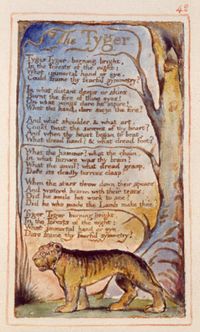
Tyger, Tyger, burning bright by William Blake. I simply loved the imagery.


“The Tyger”

Tyger, Tyger. burning bright,
In the forests of the night;
What immortal hand or eye.
Could frame thy fearful symmetry?

In what distant deeps or skies.
Burnt the fire of thine eyes?
On what wings dare he aspire?
What the hand, dare seize the fire?

And what shoulder, or what art,
Could twist the sinews of thy heart?
And when thy heart began to beat.
What dread hand? & what dread feet?

What the hammer? What the chain,
In what furnace was thy brain?
What the anvil? what dread grasp.
Dare its deadly terrors clasp?

When the stars threw down their spears
And water'd heaven with their tears:
Did he smile his work to see?
Did he who made the Lamb make thee?

Tyger, Tyger burning bright,
In the forests of the night:
What immortal hand or eye,
Dare frame thy fearful symmetry?

3. I read poetry because....
I have too. I read classics to modern. Anything, everything. I have vast and varied taste. It depends on my mood.

4. A poem I'm likely to think about when asked about a favorite poem is ....

Too many. But I think my favourite is by John Clare:

I Am by John Clare

I am: yet what I am none cares or knows
My friends forsake me like a memory lost,
I am the self-consumer of my woes—
They rise and vanish in oblivious host,
Like shadows in love's frenzied, stifled throes—
And yet I am, and live—like vapors tossed

Into the nothingness of scorn and noise,
Into the living sea of waking dreams,
Where there is neither sense of life or joys,
But the vast shipwreck of my life's esteems;
Even the dearest, that I love the best,
Are strange—nay, rather stranger than the rest.

I long for scenes, where man hath never trod,
A place where woman never smiled or wept—
There to abide with my Creator, God,
And sleep as I in childhood sweetly slept,
Untroubling, and untroubled where I lie,
The grass below—above the vaulted sky.

5. I write/don't write poetry, but..............

I do write poetry. I started out as a short story writer and don't know how I graduated to poetry. Words just flow without any reason and I have to write no matter what. I can't do without words:

I only exist without it
Poetry gives me direction,
imagination and perception.

7. I find poetry.....
Everywhere. Things I love, things I hate. In mundane things, in nature, in you, in me...you name it, I see it.

8. The last time I heard poetry....
At a poetry meet organised inter school last month in Delhi. I enjoyed poetry reading very much.

9. I think poetry is like....
soul food. I cannot live without it. I have to read it and write when muse strikes me.

Thursday, September 28, 2006

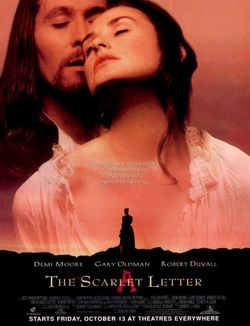
The Scarlet Letter by Nathaniel Hawthorne


I had picked this book long time back. I only got around reading it recently. After I finished it, I felt nothing has changed. A woman is still dubbed a scarlet one if she has a child outside of marriage while the man goes free. People are as fond of gossip now as they were ever before. It still interests people, who is sleeping with whom.

The novel is set in the 17th century. It was written by Hawthorne in 1850. A touching human story of a time that makes us wonder how far religious and moral extremes could take us.

The novel opens with Hester being led to the scaffold where she is publicly shamed for having committed adultery. Hester is forced to wear the letter "A" on her gown at all times. Hester carries Pearl, her daughter, with her. On the scaffold, she is asked to reveal the name of Pearl's father, but she refuses. Though her husband comes to the town, he tells her not to let it be known that they are related in anyway.

Hester moves into a cottage near the woods where she lives with her daughter Pearl. She redeems herself in the eyes of the village people by her austere and virtuous living. She with her quiet behaviour goes on about her work as a seamstress who mainly stitches funeral gowns initially. Though she goes on loving the man with whom she had the child, she cannot name him as he is a man of repute who holds a great esteem in the eyes of the people. Hester’s husband, a cold-hearted man described as “having successfully turned himself into a fiend by taking on the office of one,” moves forward with his plan of revenge.

Hawthorne’s writing is very refreshing and real. Making good use of magic realism and vivid imagery, he portrays the Puritan mindset so well that we are drawn into the world of 17th century New England complete with witches who fly on broomsticks, people who meet the Devil in the woods and a scarlet letter “A” imprinted in the flesh of Hester’s secret lover.

Despite its gloomy message, The Scarlet Letter is also a story of passion and the will to survive. In Hester, we find a woman of great courage. Who bears her punishment with fortitude. Her very exclusion from her town is as much a blessing as a punishment. Marked as an adulteress, she no longer needs to abide by society’s rigid expectations and strict morality. Her lover, on the other hand, is forced to deny his desire, his needs and even his humanity because he would not choose Hester’s fate.

This book contains a message that is as relevant and poignant as the day it was written. It’s as much about the abuses of women in a society too rigid in its moral and religious ideals to still be human as it is about two people’s will to survive. With the vivid imagery, magic realism and the profound symbolism, The Scarlet Letter is a must-read for anyone concerned about society, values and the right to be human.